
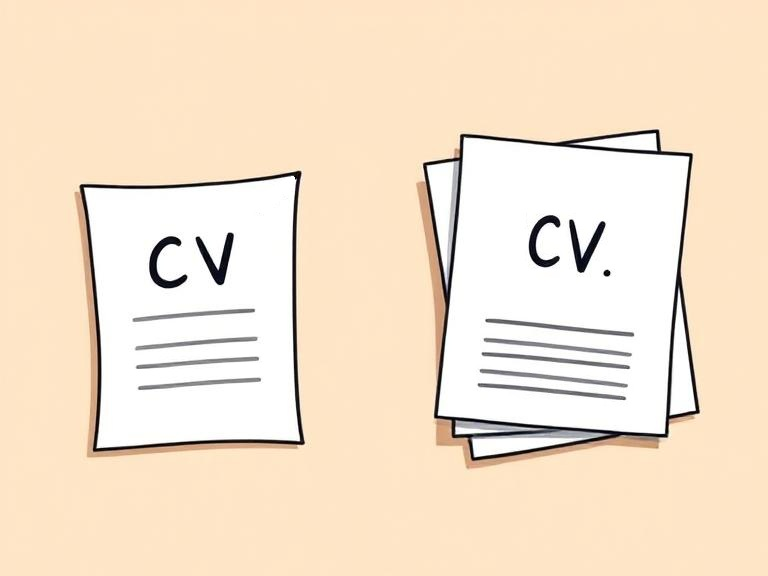
When it comes to creating a CV, one of the most common questions job seekers face is: Should my CV be one page or two? The short answer is: it depends—on your experience, industry, and goals. In this post, we’ll break down when to stick to a single page and when it’s smart to extend to two.
When a One-Page CV Is Best
A one-page CV is ideal when your experience is limited or when the role values brevity and clarity over volume. Here’s when to use it:
• You have less than 5–7 years of experience
Early-career professionals usually don’t need more than a page to showcase their education, skills, internships, and initial job roles. Recruiters expect a lean, focused document.
• You are a student or recent graduate
If you’re fresh out of school, you likely don’t have enough work history to justify a second page. Instead, highlight academic achievements, relevant coursework, and extracurriculars.
• You are switching industries
When pivoting to a new field, a concise one-pager allows you to emphasize transferable skills without including unrelated past experience that may distract from your goals.
• You work in a fast-paced or visual field
Industries like design, digital marketing, sales, or startups often favor clear, visually polished one-page CVs that showcase impact quickly.
• Most suitable roles for a one-page CV include:
- Teaching assistant or research assistant positions
- Entry-level jobs (e.g., marketing assistant, data analyst intern)
- Creative or startup roles (e.g., UI designer, social media coordinator)
- Graduate programs or internships
- Customer support or service roles
When a Two-Page CV Is Better
A two-page CV is best suited for mid- to senior-level professionals or when the role demands detailed technical or academic documentation. Choose this format when:
• You have 10+ years of professional experience
With a long career comes a deeper list of roles, promotions, achievements, and leadership examples. A second page helps present that progression clearly and without crowding.
• You work in technical, academic, or specialized fields
Roles that require specific credentials—like engineering, healthcare, or research—often demand space for publications, certifications, or complex project work.
• You’ve held many relevant positions
If your past jobs all support your fit for the current role, you can use two pages to give each one the attention it deserves. This is especially useful if you’ve had upward career progression.
• You need to include certifications, awards, or publications
Extra credentials and recognitions can set you apart—if they’re relevant. Two pages give you room to include them while still keeping the layout clean.
• Most suitable roles for a two-page CV include:
- Consulting or legal roles that require detail and documentation
- Senior or managerial roles (e.g., project manager, marketing director)
- Technical professions (e.g., software engineer, data scientist, architect)
- Academic or research positions (e.g., university lecturer, research fellow)
- Government and public sector jobs
Final Thoughts
There is no universal rule about CV length—what matters is how effectively you use the space. A compelling one-page CV can outperform a two-page one that’s unfocused. Likewise, a well-organized two-page CV may be necessary to tell a complex, experienced career story.